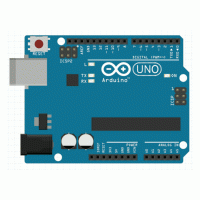

What does it take to build a geocaching box that can only be opened at sunset? A box, a button, an electronic lock, an electronic clock, and a controller that ties everything together.
Continue readingCategory: Geocaching

Anything that has to do with Geocaching
Synchronism
In 2013, we found the Seattle-Köln Exchange Multicache, which requires cooperation between geocachers from Cologne and Seattle. This led to the idea of a geocache where two people at different locations had to press a button at exactly the same time in order to be able to open their respective cache boxes. And now the idea has become a reality!
Continue reading
Winter is coming …
And now, there is more time to sit at your desk and do “nerdy” things, such as soldering and coding.
Continue reading
Parasitic Power Supply
In parasitic power supply mode, a device sucks its juice from a data line instead of from the power rail. This can be intended or unintended. In the latter case, all sorts of funny things can happen.
Continue reading
Fixing Problems … Using Super-Global Variables
Another xkcd comic that hits the spot. Except, with my new hardware debugger, this is the past 😎. Recently, I debugged one of my electronic geocaching gadgets and was positively surprised how easy it was to figure out ones own mistakes and to come up with the right fix.
Continue reading
Connecting the Dots
If you want to drive a 5×7 dot matrix display directly from your MCU, I have the right Arduino library for you. Flexible, easy to use, supporting low power operation, and a low memory footprint: DotMatrix5x7.
Continue reading
Another Piece of the Puzzle
For a recent geocache, which is a tribute to the well-known Tetris game, I wanted people to solve a simple physical puzzle (as shown in the image above). As a reward, they get a code that they can use to open a box. So, what do you have to do to make things work? And how do you make sure that you do not have to change batteries for the next 20 years?
Continue reading